
Benton County Release Date Meanings
A projected date is a current calculation, not proof that the door opened. Mississippi’s public MDOC detail uses the exact label Tentative Release on the legacy route and Tentative Release Date on the newer route. The agency warns that release types and dates can differ under state law. An actual release date records the custody event after required reviews and processing are complete. A full discharge date marks the end of the sentence, which may be later than physical release on parole or Earned Release Supervision.
The type of Benton County custody controls whether a computed date should exist. A pretrial detainee is waiting on bond, a court ruling, dismissal, transfer, or another legal event, so there may be no set release date. A person serving a local jail sentence may have an end date based on the sheriff’s and sentencing court’s records. A person transferred to MDOC enters the state sentence-computation system.
Release can also mean different destinations. A bond or recognizance release often returns a person to the community while the case remains open. Time served or local sentence completion follows the court’s order and the jail’s administration of it. Transfer to MDOC, another county, federal custody, or an immigration custodian ends one jail stay but does not mean freedom. Ask the Benton County Sheriff for the exit type and receiving agency whenever a name disappears after sentencing.
- Tentative Release Date
- MDOC’s public label for a computed date that can change.
- ERS
- Conditional community placement while the person remains an inmate under MDOC jurisdiction.
- Discharge
- The sentence endpoint documented by the controlling corrections record.
- Detainer
- A hold or request from another authority that can affect where the person goes next.
Find Benton County Projected Release
Do not apply the state search to every Benton County booking. MDOC covers people sentenced into state corrections. The Benton County Sheriff and the sentencing court control the records for an ordinary county jail episode. A federal sentence belongs in the federal locator, not the MDOC system. Correct classification prevents a truthful “not found” result from being mistaken for release.
- Determine whether the person is in Benton County Jail, MDOC custody, federal custody, or already in conditional community placement. Ask the sheriff whether a former local detainee was released or transferred.
- For a state sentence, open the official MDOC inmate search. Enter both first and last name or use the MDOC ID.
- Open the correct detail and compare the MDOC ID, date of birth, photograph, county of conviction, offense, sentence date, and location.
- Read the exact Tentative Release or Tentative Release Date field together with Location and the sentence fields. A blank field does not mean release is near.
- For a local sentence or pretrial case, request the jail release or transfer record and review the court’s bond, sentencing, amended-sentence, or time-served order.
- Ask MDOC Records for sentence computation, eligible jail credit, and the discharge certificate when the public detail does not resolve the date.
The full Benton County jail search and release-record route is set out on the Benton County released-inmate search. It pairs the sheriff’s physical custody event with the court order that explains the legal posture. That two-source check is crucial because an order date and the actual release or transfer time can differ.
Note: Match more than a name, and save the reporting agency, URL, displayed field, and retrieval date with each release-date observation.
Benton County Tentative Release Field
Mississippi’s terminology is more precise than the broad phrase “projected release date.” MDOC computes parole dates, ERS dates, tentative release or discharge dates, and maximum release dates as separate sentence events. Eligible pre-sentence time in a county jail on the same cause can affect the sentence-begin date. Multiple sentences also matter. Concurrent terms run at the same time, while consecutive terms run one after another.
The official MDOC detail example shows the photo, sentence fields, and exact Tentative Release label used in the public record.
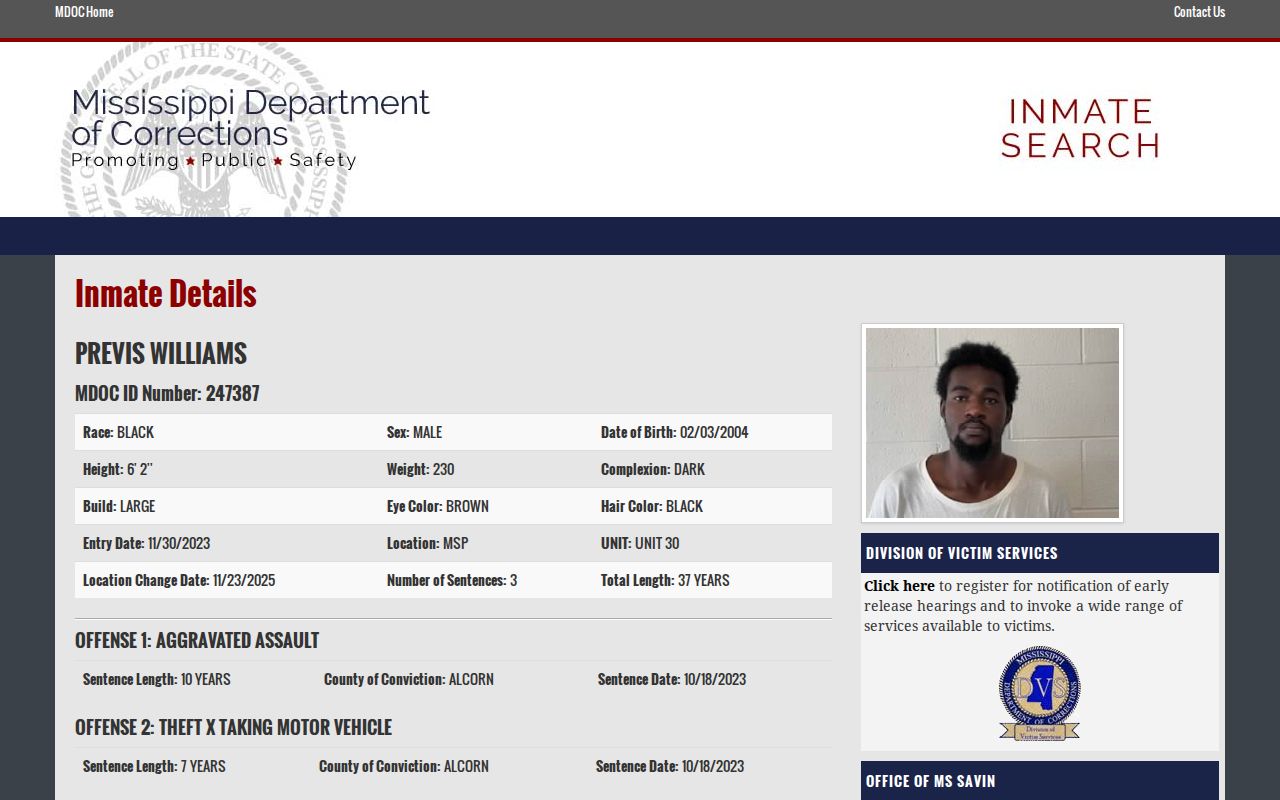
The date should be read beside the offense, sentence length, county of conviction, entry date, and location. It should not be copied without those identity and sentence checks. MDOC’s FAQ further says parole and ERS dates are not guaranteed. The agency reports that release processing can take 30 to 45 days and requires a discharge certificate, while a case manager verifies travel plans. Those steps explain why eligibility or a Board grant may precede the physical exit.
Benton County 85/15 Release Limits
Mississippi Code §47-5-138 supplies the central earned-release framework for many state sentences imposed after June 30, 1995. Qualifying conduct and performance can earn 4.5 days for each 30 days served, capped at 15 percent of the sentence. MDOC often explains this as an 85/15 structure: an eligible person may serve 85 percent in a facility and the final 15 percent on ERS.
That shorthand is not a promise of release at exactly 85 percent. Eligibility exclusions, sentence date, offense category, institutional behavior, classification, residence approval, and the governing version of law all matter. MDOC lists disqualifying categories that include life and habitual sentences, sex crimes, escape or attempt, and certain mandatory-time crimes. The older one-half earned-time formula applies under older sentence law and cannot be assigned to a newer sentence. Trusty and meritorious provisions also should not be stacked into a home calculation without MDOC confirmation.
The MDOC supervision explanation shows the 85/15 distinction and the separate roles of ERS, parole, and probation.

This framework applies to eligible MDOC sentences. It should not be imposed on a Benton County jail sentence that never entered MDOC. For that local term, ask the sentencing court and Sheriff which sentence, credit, and release order controlled. No Benton-specific jail good-time or weekend-release policy was found.
Benton County ERS Is Conditional
An MDOC detail can list Earned Release Supervision in the Location field. That is a key Mississippi release-date clue. The person may be living outside a prison while still appearing in the inmate search and remaining under state jurisdiction. Section 47-5-138 treats ERS as conditional release through sentence expiration. A violation can return the person to custody.
Physical release, ERS placement, parole, and full discharge must therefore be recorded as separate events. A family member trying to confirm whether someone left a prison may get a valid answer from the ERS location. A person seeking the sentence endpoint still needs the tentative or maximum date, later MDOC record, and discharge certificate. The Benton County post-release supervision page explains how parole, probation, and ERS are verified without treating them as the same status.
Note: An ERS location means conditional community placement under MDOC, not that every sentence duty or state record has ended.
Benton County Release Date Changes
A computed date changes when the facts or legal inputs change. The public detail cannot always show every part of that calculation. MDOC Records is the correct source for definitive sentence time, jail-credit, eligibility, and discharge questions. A court clerk holds filed orders, while the Parole Board controls parole decisions. Keeping those roles separate makes disagreements easier to resolve.
| Factor | Possible effect | Best confirming source |
|---|---|---|
| Corrected jail credit | Changes the sentence-begin calculation | MDOC Records and sentencing order |
| Amended or vacated sentence | Changes the term MDOC must administer | Filed court order and MDOC computation |
| Disciplinary loss or eligibility review | May reduce or remove earned-release benefit | MDOC record |
| Concurrent or consecutive terms | Changes how multiple sentences combine | Judgments and MDOC timesheet |
| Detainer or new sentence | May change the next custodian or extend custody | Holding agency and court record |
| Parole decision | May permit or delay conditional release | Parole Board action |
| ERS residence review | Can affect placement and processing | MDOC case manager or Records |
A detainer deserves special care. It may cause someone to leave one facility for another agency rather than enter the community. The original jail’s exit date can be accurate while the person remains confined elsewhere. Ask for the receiving agency and transfer time instead of calling every departure a release.
Confirm Benton County Release Timing
For a state sentence, use the public date as the start of verification. Then contact MDOC Records when sentence credit, eligibility, or final discharge is disputed. The research identifies MDOC Records at P.O. Box 24388, Jackson, MS 39225, phone 601-933-2889, and MDOCRecordsDepartment@mdoc.state.ms.us. A focused request can seek nonexempt master-file portions showing the sentence timesheet, jail credit, Tentative Release Date, ERS or parole status, discharge certificate, and final discharge date.
For a Benton County jail term, the official county page names Sheriff Robby Goolsby and gives Benton County Government at 190 Ripley Avenue, Ashland, MS 38603, 662-224-6300, or info@bentoncountyms.gov as the routing contact. Ask for the Sheriff’s or jail records custodian. Request the existing release or transfer event, exact timestamp, reason, authority, and receiving agency. The county has not published jail records hours, so call before visiting.
Compare that exit record with the correct court order. The Benton County Circuit Clerk page identifies the office that keeps judgments and the complete court proceeding record. The Circuit criminal query can locate a felony case by party, case, or Final Disposition Date, but its index may lag and cannot prove the exact jail exit time. Justice or municipal court may control a lower-level case that never appears in Circuit Court.
VINE can add a custody-change alert when the holding agency participates, but Benton County Jail participation was not conclusively confirmed. A released event reflects what the reporting agency sent and does not rule out another hold. Use the alert to prompt a direct check, not as a substitute for the corrections or jail record.
When dates conflict, preserve both. A court order date may show when a judge authorized release, while the jail timestamp shows when processing ended. An MDOC tentative date may reflect a sentence calculation, and a later transport or discharge record may capture the real event. Do not average them or select the earliest one. Ask the record custodian whether each value is an order date, eligibility date, projected date, posting time, transfer time, or actual release time.